
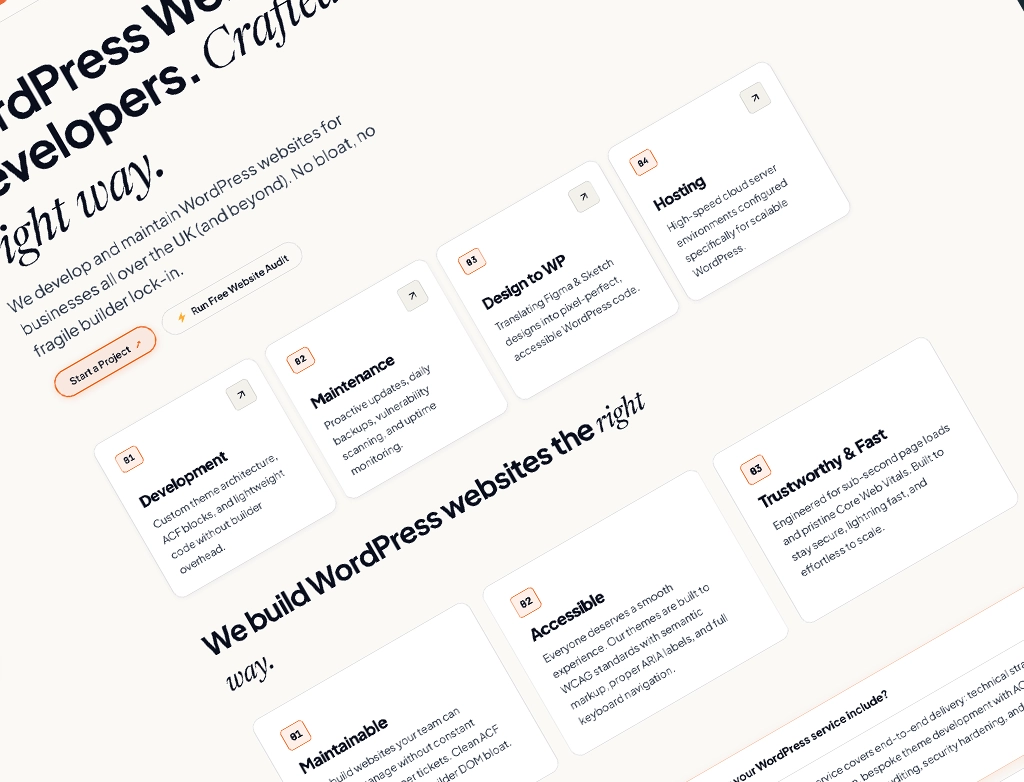
We launched a new version of our website this week.
If you had visited us a month ago, you would have been looking at a site built in Bricks Builder. It was a good site. It looked sharp, it did its job, and for a long time Bricks was our go-to tool for putting WordPress sites together.
This isn’t a piece about why Bricks is bad. It isn’t. As visual builders go, Bricks is one of the cleanest on the market, and it still has its place for certain types of projects.
Workflows evolve. And once we found a faster, cleaner way to build WordPress websites by hand — crafting bespoke templates and custom blocks to exact specification — it became clear that we probably won’t use a visual builder if we can avoid it.
Here is why we stripped our site back to the studs.
The hidden weight of twenty plugins
Our old site ran on Bricks and just over twenty plugins.
Twenty plugins doesn’t sound outrageous in the WordPress world. We routinely audit client websites running forty, fifty, or sixty of them.
Still, twenty plugins meant twenty separate codebases written by twenty different authors. Every week, we had to keep Bricks up to date alongside twenty moving parts. Every major WordPress release meant checking compatibility across a stack of third-party extras we didn’t really need.
When you step back and look at an agency website honestly, you realise something simple. We know what pages our site needs. We aren’t inventing a new layout geometry every Tuesday afternoon. We need clear service pages, fast articles, a product showcase, and an easy way for clients to talk to us.
Carrying a full visual layout engine in the database just to render pages whose structure rarely changes didn’t make sense anymore.
So we wrote our own theme from scratch.
Five plugins. Two of them our own
The new site runs on a custom theme built specifically for our content, paired with custom Gutenberg blocks that give us clean fields to edit text and media without touching layout code.
And instead of twenty plugins, we now run five.
Two of those five are our own in-house tools. The first is BBI Cookie Privacy Control Pro, which handles our UK GDPR consent and Google Consent Mode v2 without external SaaS scripts slowing down the page. The second is our own BBI Site Watcher plugin — a lightweight monitor we built to help monitor clients sites that take out a maintenance package.
Beyond our own tools and ACF Pro for our custom block fields, there is only a forms plugin and an SMTP mailer.
Nothing else.
Even our SEO metadata, Open Graph tags, JSON-LD schema, and 301 redirects are built straight into the theme itself.
The funniest part of the rebuild came at the very end, when we tested a caching plugin. On almost every WordPress build over the last decade, adding a caching plugin is one of the last boxes you tick before launch.
We installed one, ran our benchmarks, and then turned it off and ran them again.
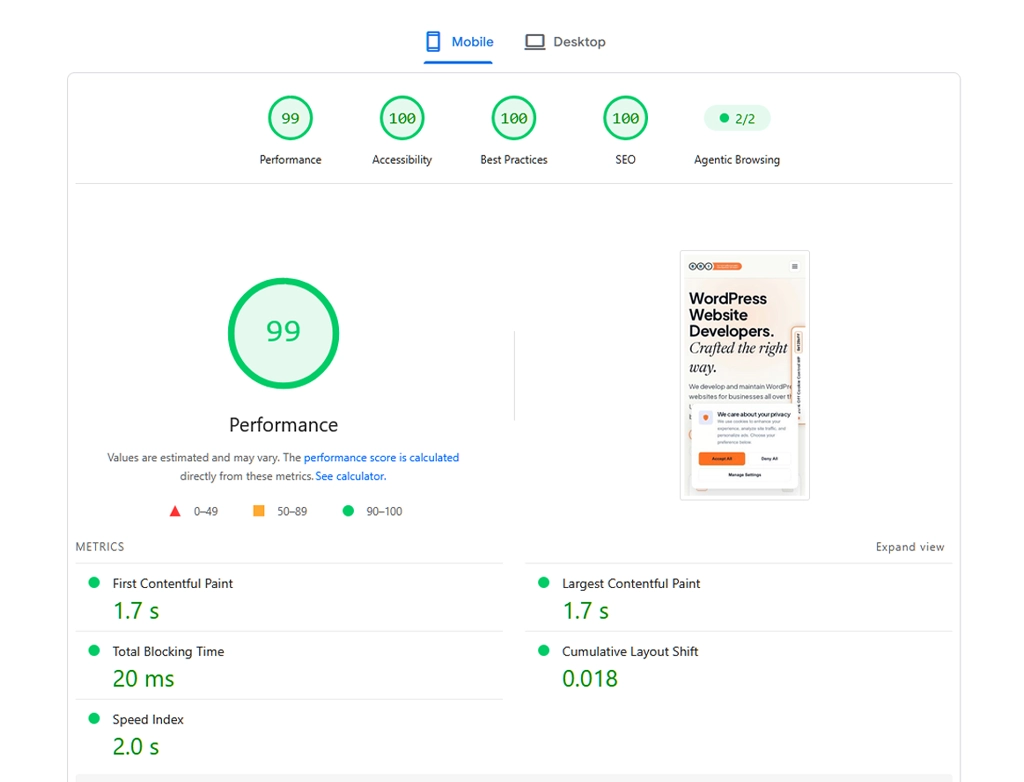
Oddly enough, the site ran quicker without it. When your HTML is light, your CSS and JavaScript are minimal, and the server isn’t wading through twenty plugins on every request, the overhead of a caching plugin can actually cost more than it saves. So we deleted that too.
What happens when you own the code
There is another side to ditching a page builder that doesn’t get talked about enough.
When you build inside a visual builder, your imagination is subtly boxed in by what the builder’s elements and add-ons can do. If you want to build something genuinely interactive, you either start hunting for another plugin or you end up fighting the builder’s DOM wrapper structure.
Because our new theme is pure custom PHP, CSS, and vanilla JavaScript, adding bespoke logic into the site became effortless.
We wanted to build something useful for visitors — not a generic contact popup, and not a credit-burning chatbot, but a proper technical tool that helps people see what is actually going on under the bonnet of their website.
So we built our own Free Website Speed & Technical Audit Tool directly into the theme.
You can paste any live website URL into it — whether it runs on WordPress, DNN, Shopify, Wix, Squarespace, or custom code — and in a few seconds it inspects the live server response speed, render-blocking scripts, CMS and page-builder footprint, heading hierarchy, accessibility markup, and UK GDPR cookie compliance.
Then you can click between four different focus areas — Speed, Redesign, Security & GDPR, or Technical SEO — and see a tailored breakdown and action plan on the spot. If you want our help fixing what it finds, one click sends the report straight into our enquiry form.
No third-party plugin. No monthly SaaS fee. Just clean code built into a theme we control from top to bottom.
Simpler is almost always better
Moving away from Bricks wasn’t about chasing a trend. It was about removing friction.
Fewer plugins mean fewer updates that can go wrong on a Friday afternoon. Lighter templates mean pages that load in the blink of an eye without needing three layers of caching to hide the bloat. And writing our own theme means that when we have an idea for a tool like our live website scanner, we can just build it.
If your own website feels like it is carrying too many plugins or fighting against an old page builder, run it through our free website audit tool or get in touch with our team. We would love to show you how much faster life gets when you simplify.